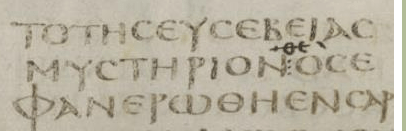
A while back I wrote a brief commentary on 1-2 Timothy for Bible translators. In I had to deal with the most important textual variant (place where the manuscripts differ one from another). It appears in 1 Tim 3:16: “Beyond question, great is the mystery of godliness, ___ was manifest in the flesh” (NASB version).
In English we would translate the key phrase EITHER as:
“God was manifest in the flesh.” KJV (“manifested”, NKJV)
Or
“He was manifested in the flesh” (ESV; similarly NET, NASB, NIV, most others).
Or
“which (mystery) was manifest in the flesh (Douay-Rheims translation).
This third option is well-known from the Latin Vulgate. In his tractate On the Trinity, Augustine quoted that text. As a trinitarian, Augustine would have been very pleased to see an affirmation of the deity of Christ in 3:16. But NO! He quotes it thus:
For this is “the great mystery of godliness, which [= which mystery, as indicated by the Latin pronoun “quod”] was manifest in the flesh, justified in the Spirit, seen of angels, preached unto the Gentiles, believed on in the world, received up into glory.” On the Trinity 4.20.27, NPNF1 3:84.
I know of only one English version that takes that option, the Douay-Rheims, which was in fact a translation of the Latin; the modern Catholic version, the New American Bible, translates it as “who”).
I. THE EVIDENCE
The evidence in favor of “he” or “who” (hos/ὅς) is very strong: the most ancient manuscripts, Sinaiticus, Alexandrinus, many fathers, and all of the ancient versions except for the Latin. Other manuscripts have “that which” (ho/ὁ). In the fathers, the 2nd century To Diognetus 11.3 (Holmes) has “he” – “This is why he sent the Word, namely, that he might appear to the world . . .” That is, the “external” evidence is firmly on the side of “he/who”, and all modern versions take that as the text Paul originally wrote. Some add “Christ” to remind the reader that is Christ to whom the “he” refers (CEV, NLT).
On the other side of the ledger, the first manuscript to mention “God” (theós/θεός) dates from the 9th or 10th century AD (Ψ); all earlier manuscripts were older ones that were later “corrected” by medieval scribes. The first quotations in the fathers of the church occurs only in the 4th century – for example, Gregory of Nyssa Against Eunomius 5.3 NPNF25:176. The Textus receptus follows that reading, “God,” and for that reason the King James and New King James have it.
[Here is the relevant passage in Sinaiticus; the darker ink on the second line, right, shows where a later scribe altered the original 4th century text, changing it from hos (“he, who”) to theos (“God”)]:
II. THE EXPLANATION OF THE THREE READINGS
One step in textual criticism is asking, Which reading best explains the other reading(s)? In this case the solution is relatively simple:
- “He” was very likely the original.
- “He” was smoothed to “that which” in a few manuscripts.
- To the eye, “he” looks very like “God in the ancient Greek manuscripts. By the phenomenon of nomina sacra (sacred names), some words were written with an abbreviation – the first and second letter, plus a horizontal bar above them. Thus, some Scribe apparently read ὅς (he) and take it as θεός (God).

Some see in 1 Tim 3:16 NIV and in other versions some sort of attack on the deity of Christ. They do not perceive that this is not an issue of doctrine, but of historical evidence. Neither can they explain how the NIV has so many verses that affirm the deity of the Savior, including this verse from another pastoral epistle – “the blessed hope – the appearing of the glory of our great God and Savior, Jesus Christ” (Titus 2:13 NIV).
Our verdict: Paul wrote “he who was manifest in the flesh” is what Paul wrote and what he meant. The deity of Christ is taught throughout all modern New Testament versions.
“The Text of 1 Timothy 3:16,” by Gary S. Shogren, Professor of New Testament, Seminario ESEPA, San José, Costa Rica
 Open Our Eyes, Lord!
Why did they kill Tyndale over terms ,,, asking I read the account…..he was a threat ?
Hi Franz, they killed him for rendering the New Testament into English, whereas they wanted it to stay only in Latin or, for scholars, also Greek. https://openoureyeslord.wordpress.com/2020/06/30/william-tyndale-is-my-hero/
Thanks ,,,,