There is a subset of Bible teachers who are certain they have all the answers. “The Bible is God’s Truth!” they say. “I preach the Bible!” they say. “Therefore, I have all the answers!” they say. They do not say “I do not know what the Bible says” or “The Bible doesn’t speak to this point.”
Let’s break this down:
- Isn’t the Bible God’s truth? Yes!
- The Scripture reveals all the important aspects of God’s truth? Yes!
- Does the Bible’s truth reveal all of God’s truth? No.
- Are we teachers responsible to know the Bible through and through? Yes.
- Should we act as if we understand everything the Bible says? No!
- Does a solid knowledge of the Bible mean we understand the Bible? No! Saul of Tarsus had memorized the Old Testament in Hebrew long before he met Christ and realized he had been all turned around on its meaning.
For all these reasons and more, I harbor suspicions about people who cannot bring themselves to say, “I do not know” or “I do not know off the top of my head.”
The Lord calls us to “exegetical humility” = we cannot claim to know what the text says in all cases, let alone things not presented in Scripture.
If a Bible teacher is more concerned with his or her reputation, they might give a wrong answer quickly; rather than delay in order to find a good answer. James 3 warns them that they will be judged strictly; I assume that honoring one’s reputation above the Bible is one of the things that will come up on Judgment Day.
Let’s go in another direction: since our knowledge of God’s truth is fallible, we might change our minds about what the Bible teaches as we move through its pages.
The towering theologian Augustine (around AD 400 in North Africa) wrote an entire book called the Retractions. In the English version it holds almost 300 pages of Augustine saying, “In the past I said ABC, I later changed my mind, now in hindsight I think CDE or XYZ is closer to the truth.” In other words, “I thought I knew, and I told my followers what I sincerely thought I knew; but I guess I didn’t know.” [1] Contrast Augustine with one famous American preacher who stated emphatically, A preacher should never correct himself. Even if he was wrong.
Some people I have met know the Bible much more deeply than I do. Nevertheless, a key trait of their personality is an unassuming nature. They are spiritually “modest”. Modesty is not, as one might gather from the parlance of the church, limited to clothing style, nor does the virtue apply only to women. All men and women, girls and boys, teachers and non-teachers, must “be completely humble and gentle; be patient, bearing with one another in love.” (Eph 4:2 NIV).
Let’s return to Augustine, whom we left waiting in the 5th century. In my Bible translation work, I spent some time on Genesis 1:1. I was also reading through Goldingay’s recent commentary by Baker. Goldingay points out that Genesis 1:1, “In the beginning, God created the heavens and the earth,” refers to creation as we earthlings perceive it, but it gives no clue as to the activities of God before then. For example, when did God create the angels?[2]
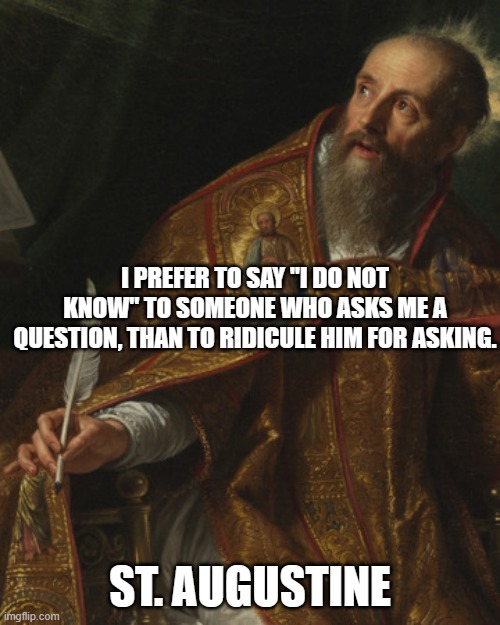
He then refers to Augustine’s Confessions (in my opinion, a must-read), a quotation that I heard long ago and had forgotten. [3] I broadly paraphrase:
So, let’s say someone is curious about: “What did God do before He made heaven and earth?” I hear that some people dodge such questions and shame these seekers by making them the butt of a joke: “Why…He was getting hell ready for people like you, who pry into such deep questions!” We should not laugh at people with these questions. At least, that would not be my answer. I should much prefer to reply: “I do not know,” when I really do not know, than to ridicule a person who asked a profound question; nor would I approve of someone who gives the seeker an arrogant answer. Confessions Book 11, Chapter 12
If Augustine himself could bring himself to say, “I do not know” – speaking the truth in love, after all! – that is worth our imitation.
Relevant here is the “insight” I heard (it was many decades ago, and I have no footnote!) from a “prophecy expert” in his exposition of Rev 19:12 – when Christ comes, he “had a name written, that no man knew, but he himself.” The preacher then went on to say that, while he could not know for sure, he sincerely believed the name was [and he drove right through the warning barrier and shared his opinion].
Augustine’s hero the apostle Paul too is a model in humility. When he described the Second Coming he admitted that he – who had ascended to Paradise and heard mysteries! – had only partial knowledge of God’s truth: we are like children in this age, meaning, now we “know only in part” (1 Cor 13:8-12).
As for prophecies, they will pass away; as for tongues, they will cease; as for knowledge, it will pass away. For we know in part and we prophesy in part, but when the perfect comes, the partial will pass away. When I was a child, I spoke like a child, I thought like a child, I reasoned like a child. When I became a man, I gave up childish ways. For now we see in a mirror dimly, but then face to face. Now I know in part; then I shall know fully, even as I have been fully known. (1 Cor 13:8b-12 ESV).
Notice that Paul includes himself in the camp of “Those Who Partially Know.” [4] I infer for those who “know Greek” and want a free pass from humility: Paul knew Greek and Hebrew and Aramaic more than anyone alive today, and even he knew his limits! [5]
Beginning in the 2nd century, groups such as the Montanists, Gnostics, Manicheans, perhaps others, claimed to have received fresh insight or revelation and thus knew more than Paul did. They used 1 Cor 13, not as an expression of justifiable humility, but to put Paul in his place: he did not know God as well as we in our new group do!
The church fathers leapt to Paul’s defense. Augustine, once again, help us out! [6]
And so every heresy arising under the name of the Paraclete will have the boldness to make an equally plausible application to itself of such texts. For there is no heresy but will call itself the truth; and the prouder it is, the more likely it will be to call itself perfect truth: and so it will profess to lead into all truth; and since that which is perfect has come by it, it will try to do away with the doctrine of the apostles, to which its own errors are opposed.
And so it continues until today: one of the definitions of a Christian cult is that its leaders claim special knowledge. “The leadership claims the right to define what is truth and what is not truth. In Christian cults, there may be a focus on the ‘Full Gospel’ of Jesus Christ, which (coincidentally) has been revealed only to those inside the group. The lines between ‘God’s will’ and the leader’s will are blurred.” [7] This leads to toxic power structures in which the leader becomes the supreme authority; in some cases the only channel for God’s message on the planet. In the example we mentioned above, according to multiple websites, the preacher who never changed his mind – or at least would never admit it! – never strayed too far from Baptist doctrine, but still he created and presided over a cultic following.
Let’s break “I do not know” into its two main expressions.
A. I do not know a thing because I have not properly explored that thing.
B. I do not know a thing because that thing cannot be known at this time.
A and B come into play on a question like this: “I do not understand the trinity!” Why, of course they do not! But as Dr. Jan Poorman said, “Just because it’s a mystery does not mean that it cannot be more fully understood.” [8] Augustine wrote a ton about the trinity, including his 15-book work written over many years, “On the Trinity.” He himself did not fully comprehend the truth. [9]
I was talking with a friend on Facebook about A, and whether seminary professors should answer a student’s questions with, “I do not know.” We both agreed that (1) “I do not know” is appropriate; but we had to nuance it further. I mentioned it might be relevant to remember that in some cultures, if the teacher admits he or she does not know a thing, this may cause students to lose confidence. Thus, the teacher needs to weigh the risk. So let’s add a helpful option, (2) “If I have to say ‘I do not know/recall right now,’ I could add, ‘But let me look into it and I will come back with an answer.’”
Let’s suggest a third option. In my seminary days, at the end of Greek class I asked my teacher if he could identify a certain rare verb form for me. He said, “Let’s go the go the library, there is a special dictionary that will show you what it is.” In other words he was communicating, “I may or may not know; I do know where you can find out; and it would be better if I showed you where to find the answer in a book that you can use for your future questions.”
Hence, let us add another plan of action: (3) “I may or may not know, but let’s you and I find the answer together.’”
NOTES:
[1] http://augnet.org/en/works-of-augustine/writings-of-augustine/2148-the-retractions/ I might mention a more recent work: How I Changed My Mind about Women in Leadership: Compelling Stories from Prominent Evangelicals: Zondervan, Johnson, Alan F., Dallas Willard: 9780310293156: Amazon.com: Books
[2] John Goldingay, Genesis (Grand Rapids, MI: Baker Academic, 2020), 43.
[3] CHURCH FATHERS: Confessions, Book XI (St. Augustine) (newadvent.org).
[4] I, along with almost all commentators, believe this clearly refers to the Second Coming, not to the completion of the canon, which Paul never mentions; nor the maturation of the church. With a partial exception of Chrysostom around the year AD 400, all of the church fathers agreed with this futuristic meaning of “when the perfect comes”. Some today point to the neuter substantive adjective to teleion/το τελειον and assert that it must mean “the perfect thing”, that is, the complete canon. None of the Greek Fathers saw the Greek in that way; they translated it as I do, as “perfection” and nothing more. Of course, I and the good company I keep might be mistaken in our exegesis! See my article 1 Cor 13 – when and how will “the perfect” come? – Open Our Eyes, Lord! (openoureyeslord.com)
[6] Augustine, Contra Faustum Manichaeum 32.17, emphasis added. https://www.logoslibrary.org/augustine/faustus/3217.html
[7] “Am I in a CULT?” [Series: Testing 4 Truth, #3] – Open Our Eyes, Lord! (openoureyeslord.com)]
[8] https://mcgrathblog.nd.edu/st.-augustines-analogy-for-understanding-the-trinity
“When ‘I do not know’ is the best answer a Bible teacher can give,” by Gary S. Shogren, PhD in New Testament Exegesis, professor at Seminario ESEPA, San José, Costa Rica
 Open Our Eyes, Lord!
I thought the observation that some cultures saying “I don’t know” would cause students to lose confidence in their teacher was an interesting point. I assume you were speaking of other ethnic cultures, but leaders in a church also contribute to subcultures which receive truth in different ways. A leader that is not afraid to be humble in response to a question also contributes to a culture where it’s OK to admit limits to our knowledge.
Hi, thanks, I do agree. Gary
“The Scripture reveals all the important aspects of God’s truth? Yes!”
Not really. The Bible doesn’t reveal the Trinity, which is a pretty important aspect of Christianity. I believe it was the First Council of Constantinople (381) that finalized the relationship between God, Jesus, and the Holy Spirit, more or less.