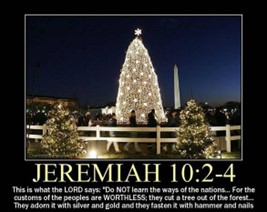
This is taken from my book Myths that we Christians Believe, available from Amazon.
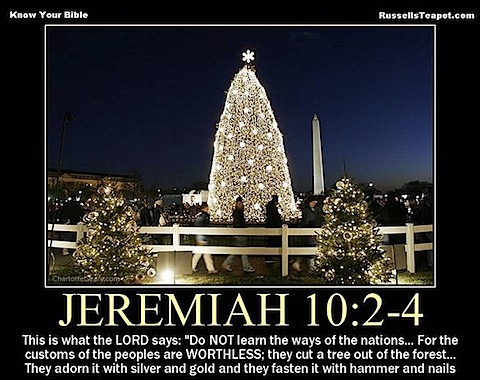
I first heard about the Pagan Christmas Tree during my years in Costa Rica, and only later saw it in the English language. The meme is one example, showing the Christmas tree that they annually place in front of the White House; it stands at 5 or 6 meters. Under the picture is a warning, taken from Jeremiah 10:2-4 NIV – “This is what the Lord says, ‘Do not learn the ways of the nations . . . for the practices of the peoples are WORTHLESS; they cut a tree out of the forest . . . They adorn it with silver and gold; they fasten it with hammer and nails . . .’”

The meme’s message is clear: Christmas trees are idols; they were specifically described and condemned in Jeremiah; and thus the White House worships a false god, along with all who decorate a Christmas tree!
If we are going to accuse people of idolatry – the most extreme sin of all – we need to be extremely careful about the details.
Examined in context, does the log of Jeremiah even resemble a Christmas tree?
Well, both are made out of wood, but from there on, there is little resemblance:
- Jeremiah talks about a piece of wood, with its branches lopped off. A Christmas tree is a whole tree, with most of its natural branches intact, the newer, narrower ones on top and the wider on the bottom, lending it its familiar conical shape.
- Jeremiah speaks of a craftsman who shapes it with a tool (in his context, that would be to make it look like a human or animal); a Christmas tree is not shaped in that way.
- In Jeremiah they “adorn” it, but a better translation is to cover the wood with sheets of beaten silver and gold. This is precisely what is described in the Law: “The images of their gods you are to burn in the fire. Do not covet the silver and gold on them, and do not take it for yourselves . . .” (Deut 7:24 NIV). The Christmas tree has no metallic sheets, nor for that matter silver or gold.
- In Jeremiah, it is nailed down, so it does not topple over; a Christmas tree – like any vertical object – has to be stood upright, but not nailed to the floor.
The problem of anachronism
An anachronism is something that is not in its appropriate time period. For example, “Jeremiah looked at his watch” would be an anachronism. Calling the log of Jeremiah a Christmas tree is a glaring example of anachronism, projecting into the 7th century BC something that simply did not exist back then. The Christmas tree as we know it was invented in the 16th century by Martin Luther to honor the birth of the Savior; another account states is that it was invented by Boniface in the 8th century. Either way, this would mean that Jeremiah would have been condemning the Israel of this day for honoring an object that would not exist for many centuries! And if someone wants to claim that pagans have always liked to use trees in some fashion, we could respond: pagans for thousands of years have, like us, used: water rituals; food rituals; sacred writings; singing; special days; night meetings; day meetings; laying on of hands; offerings; recitations; prayer; prophecy; they use light and darkness as spiritual categories, as well as clean and unclean and a host of other things that we know as Christians. The difference is that we do them to honor Christ, under the direction of God’s revelation. Otherwise, we can fall into the trap of confusing one thing with another, as does this “concordance” of Christmas Trees:

Let Scripture interpret Scripture
Jeremiah 10 has to do with the worship of idols. These were the wooden or wood-core statues that were “the ways of the nations” of his own day. And the prophet writes in the style of many Jews throughout history, following the outline: God is the only true God; idolatry is the worst sin; God is powerful, alive, he speaks, he hears, he answers prayer and saves his people; the idol – whether Baal, Asherah, or another – looks like a human being but is weak, dead, mute and deaf, cannot walk or move at all (its “feet” are nailed down!), cannot hear your prayers or save you.
The reader must push beyond the few verses that could possibly look like a Christmas tree, to see how typical is Jeremiah’s denunciation. His was one of a long tradition of mocking statues, not Christmas trees: 1 Kings 18:27; Isaiah 30:22; 37:19; 40:19-20; 44:10-20; 45:20; Hosea 4:12-13; 13:2; Habakkuk 2:18-19; Psalm 115:3-8; Psalm 135:15-18; Paul in Romans 1:22-23; and again in 1 Corinthians 12:2 NIV – “You know that when you were pagans, somehow or other you were influenced and led astray to mute idols.”
Although the following are not part of the Jewish canon, they follow in the same tradition; you can look up Wisdom of Solomon 13:10-19 on BibleGateway.com. Likewise from Letter of Jeremiah (6)44, 49-50 NRSV – “They are made by carpenters and goldsmiths; they can be nothing but what the artisans wish them to be . . . Since they are made of wood and overlaid with gold and silver, it will afterward be known that they are false . . . It will be manifest to all the nations and kings that they are not gods but the work of human hands and that there is no work of God in them.” (see also (6)8-16) They are “made of wood and overlaid with gold and silver.”
Jeremiah 10 is not speaking about a Christmas tree that stands indoors and is covered with baubles and tinsel; he speaks of a statue of a human being, carved from wood and then overlaid with silver and gold sheets, and then propped up.
Alexander Hislop, in his (in)famous tome The Two Babylons, insisted that “the Christmas tree, now so common among us, was equally common in Pagan Rome and Pagan Egypt.” He could not prove this point. Sometimes an idol is made using a tree and sometimes not, but one has to begin assuming that, sometimes a tree is just a tree. Hislop, well known for putting his imagination above historical research, should not be used for proof of any Christmas tree before the 8th or perhaps 16th centuries AD.
By all means, if you find that for you, a Christmas tree becomes your idol or a temptation to worship a foreign god, take it down! But a Christmas tree is not by definition a foreign god.
And while we’re talking about anachronisms: did Nahum predict the 20th century invention of the automobile?
After all, he says, “The chariots storm through the streets, rushing back and forth through the squares. They look like flaming torches; they dart about like lightning” (Nahum 2:4 NIV). So say (too!) many people: This prophecy reveals the future! In the days of Nahum, chariots did not have headlights and did not move like lightening. But in our day there are fast cars, cars with headlamps that can even stay on during the day.

NO.
The problem again is one of context, and of people forgetting that Scripture interprets Scripture: Nahum is speaking of an invasion of the walled city of Nineveh (see 2:7), in the year 612 BC, not about the 20th or 21st century. The chariots are not “horseless carriages”, but as Nahum said, “chariots” – the Hebrew rakav indicates riding an animal or being in a chariot drawn by an animal. Nor did he say that the chariots would have “torches”/headlights, but that the chariots would move swiftly, “like flaming torches . . . like lightning.”
And finally, the smart weapons.
While we are here, let’s add one more anachronism. Jeremiah 50:9 NIV says, “Their arrows will be like skilled warriors who do not return empty-handed.” For prophecy preacher Chuck Missler, this predicts “smart weapons” that are guided by internal computers! But again, the text says nothing of the kind. The prophet was speaking of weapons from the 6th century BC, and his point is that the arrows are shot with extraordinary accuracy so that they seemed like skilled warriors, thus assuring the destruction of Babylon in that era: “Babylon will be captured.” As it was in 539 BC. Jeremiah was not predicting the warfare of the 21th century but an event from two and half millennia earlier. To say otherwise is to twist God’s Word and make it mean something it was never intended to say.
SUMMARY:
- The carved log in Jeremiah 10 and a Christmas tree are not even similar objects; the only thing they have in common is that both have some connection with wood
- Jeremiah was talking specifically “to Israel” about a contemporary practice, worshipping a carved statue; he was not speaking anachronistically about a practice many centuries in the future
- The carved log in Jeremiah is a typical description of a wooden statue covered in metal plating
- Like other Bible writers, Jeremiah makes fun of the idols for their weakness
- Nahum, without a doubt, was speaking about chariots. Not cars, not Jeeps, not armored personnel carriers
- Jeremiah did not predict smart weapons
OUR SOURCES:
Roger Pearse, St Jerome on “Christmas Trees” in Jeremiah 10 – Roger Pearse
In Spanish: “Totem Poles, Christmas Trees, and Obelisks: Part 2.” https://kad-esh.org/es/totems-arboles-de-navidad-y-obeliscos-parte-2/
The White House’s Christmas Tree and Jeremiah 10. https://redeeminggod.com/wp-content/uploads/2013/12/Christmas-Trees-Idols.jpg
Smart weapons: Chuck Missler, “Technology and the Bible, Part 2.” https://www.khouse.org/personal_update/articles/2008/technology-statements
“Did Jeremiah condemn Christmas trees? NO!” by Gary S. Shogren, PhD in New Testament Exegesis, Seminario ESEPA, San José, Costa Rica
 Open Our Eyes, Lord!
This article sheds light on a common misconception regarding Jeremiah’s condemnation of Christmas trees. It clarifies that the biblical context is often misinterpreted. Instead of condemning holiday traditions, the focus should be on the spirit of the season. Embracing joy and togetherness is what truly matters during Christmas!
https://beruki.by/~berezovka/
Thanks, blessings!
Thank you for this simple but powerful insight and logic. I will enjoy Christmas trees this holiday season without doubt or condemnation.
🙂 Thanks.