
Paul said in Colossians 1:19-20 – “For God was pleased to have all his fullness dwell in him, and through him to reconcile to himself all things, whether things on earth or things in heaven, by making peace through his blood, shed on the cross.”
The nails in Jesus’ time were handmade. And so, after a crucifixion, they removed them from the wood to “recycle” and use them again, perhaps in the next execution.
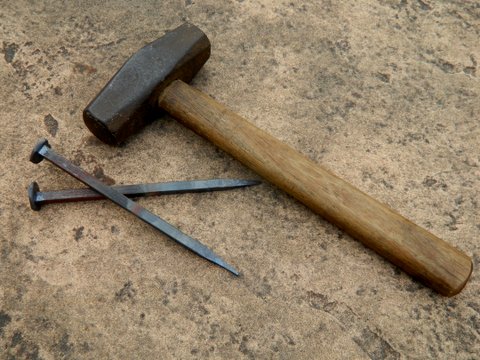
But did you know this? Crucifixion nails supposedly had magical powers to ward off evil, cure diseases and serve as good luck charms. And so before they could be recycled, some were stolen from the cadavers immediately after the execution and even robbed from tombs (from F. T. Zugibe, The Crucifixion of Jesus: a forensic inquiry).
Imagine then, that there were people walking around with nails used as pendants, things that had pierced the flesh of a human being. And there were people who dared to enter tombs to remove them from corpses to use or sell. And all that to try to gain a little “magic power”!
Thank God, we don’t need magic, amulets, abracadabras, blessed oil, or holy water to feel safe in the world. According to Paul, we are reconciled to God, we are friends with him and he gives us full acceptance, through the cross of Christ. We don’t need anything magical or religious or even political or firearms or increased military to feel cozy – only, as Paul goes on to explain, “that we may stand firm in the faith, well grounded and steadfast, not abandoning the hope that the gospel offers.” (Col 1:23)
On another note: the Jehovah’s Witnesses teach that Christ was impaled on a stake, and that the traditional “cross” is a pagan symbol, introduced by the Catholic church in order to pollute the gospel. Although historically possible that he could have been killed on a stake, what Romans called a Crux Simplex, there is no evidence for it in Jesus’s case. Yes, the crosses were in different shapes – a capital T shape (Crux Commissa) or an X shape (Crux Decussata), the weight of literary and archaeological evidence indicates it was a cross in the traditional shape, not a stick or stake. [Addendum: I just saw someone point out that John 20:25 completely undoes the “stake” theory. Even in the Watchtower’s New World Translation it is explicit that two nails went through Jesus’ hands, not one: “Unless I see in his hands the print of the NAILS and stick my finger into the print of the NAILS and stick my hand into his side, I will certainly not believe.” Two nails means the hands were not nailed to one stake, which would require but one nail. The JWs’ explanation of this in their Questions from Readers site is truly waffly: “well, no-one really knows, maybe when Thomas said ‘in his hands the print of the NAILS’ he was really thinking ‘in his hands and feet’, etc.” I offer that, the Jehovah’s Witnesses’ insistence on the “stake” has less to do with history or any theological importance – after all, Jesus’ death, in whatever form, accomplishes the atonement! – but as in many sects, it is a device for “proving” that they are closer to the original, untainted faith. Thus making people wonder if they shouldn’t become a Jehovah’s Witness.]
Another note: There are so many documentaries about the historical Jesus, and often they pick out the most contrarian view: so a professor announces, “Yes, you heard Jesus was crucified this way, but I will reveal the true method!”
That early Christians thought the Lord died on a traditional cross is shown in an early hymn: “I extended my hands and hallowed my Lord, For the expansion of my hands is His sign, And my extension is the upright cross.” (Odes of Solomon 27). Another Christian of the 2nd century said Jesus was hung just like the Passover lamb was hung, that is, on two crossed spits of wood (Justin Martyr, Dialogue with Trypho 40). Athanasius said in his famous On the Incarnation of Christ ch. 25, that in his crucifixion, Jesus held wide his arms to embrace humanity: “For it is only on the cross that a man does with his hands spread out. Thus it was fitting for the Lord to bear this also and to spread out his hands, that with the one he might draw the ancient people and with the other those from the Gentiles and unite both in himself.”
The same historical data help settle the question of whether they crucified them by nailing them or by tying them with rope to the beams. The evidence says that both were possible, and in the case of Yehohanan, who also was crucified in the first century, they nailed his feet but tied his arms with rope. In the case of Jesus, the gospels clearly state that they used nails in his hands; and of they course could have also used ropes on his wrists or arms.

“The Cross and the Nails,” by Gary S. Shogren, Professor of New Testament, Seminario ESEPA, San José, Costa Rica
 Open Our Eyes, Lord!
This is more of a question? Have you heard of a book called “Holy Nails of Christ on the Cross”? The reason why I am asking you this is because my last name is or in German was Silbernagel and now Silvernail and according to my Genealogy going way back is that one of my relatives made the nails that they used to nail “Christ” to the cross. Would you have any idea where I might find any anymore about this.
Dick Silvernail
Omaha, Nebraska
Hello! I would have to be very doubtful about such a thing. I have just looked up the story and it is one of dozens that make claims about the so-called “relics” – splinters of the cross, the veil of Veronica, the skull of John the Baptist. Most of these are medieval inventions and are entertaining stories (that is, they sell a lot of books) rather than historical fact. Sorry to disappoint you! Gary
Dear Gary, I really liked this article. I am sure Jesus was nailed to the cross. I have really grown in my Christian faith. I have the Holy Spirit in me because I love everybody, want to help everybody, and I have no love for gathering material things to me. I am a new person and I don’t worry and have peace of mind. Love Phyllis
Thanks, Phyllis, and many blessings!
ThANKS SO MUCH, Gary, for “The Cross and The Nails” article. I t was so interesting and I never knew all those things. At my Old Age I am still
learning new things.
Marie, what a pleasure to hear from you! And I am pleased that you found a blessing in it. Blessings! Gary (and Karen)