It’s summertime, let’s stroll down the boardwalk! Inevitably there's someone drawing chalk pictures of self-conscious passersby. His caricature is a sketch of a person which exaggerates some aspect of one’s appearance or character. At the beach, it’s meant to be fun; on the editorial page it might demean. In some hands, it is a weapon:... Continue Reading →
Frenemies of Christ
Have you met the guy who says: Yes, I’m a follower of Jesus, but I’m not a “churcher.” I have fellowship with my Christian friends, we pray together, we talk over coffee, we discuss the Bible, we have a commitment to hold each other accountable. These guys are my “church.” And they are more serious... Continue Reading →
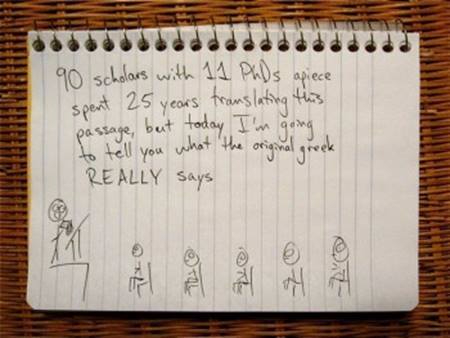
“But the Greek REALLY says…” Why Greek and Hebrew are not needed in the pulpit, Part 3
In Part 1 and Part 2 I offered one individual's philosophy of Expository Preaching without Ancient Words: I use the biblical languages, virtually daily. [1] I cannot remember the last time I did not study the Hebrew or Greek when I was preparing a sermon. I cannot remember the last time I did use a... Continue Reading →
Review of my Thessalonians commentary
The Review of Biblical Literature just published its review of my Zondervan commentary: http://www.bookreviews.org/pdf/8733_9615.pdf The only objection that I might offer is that he seems to have misread my study of the textual variants ηπιοι versus νηπιοι in 1 Thess 2:7. The fact that he say "nepioi" and read it as "epioi" was, ironically, the... Continue Reading →
“But the Greek REALLY says…”: Why Hebrew and Greek are not needed in the pulpit, Part 2
In Part 1, I argued in favor of a sharply minimalist use of ancient Hebrew and Greek words during a sermon, especially if there is no compelling purpose or, worse, if the goal is to impress the crowd: it is a pitiable housepainter who departs the job with his scaffolding still up, hoping you’ll notice... Continue Reading →
“But the Greek REALLY says…”: Why Hebrew and Greek are not needed in the pulpit, Part 1
Para la versión castellana, vaya AQUI. Come with me to ESEPA Seminary in Costa Rica: we meet at night around a table, and with me are all my advanced students of Greek. Throughout four semesters we have studied the ancient dialect, koinē, and they have found blessings as they read the New Testament in the... Continue Reading →
What Would a Mother Do? [Studies in Thessalonians]
(please feel free to use this for a sermon on Mother’s Day, adding in stories of mothers you know) Let’s take a stroll past the Mother’s Day card rack: For Mother For Mother, Sentimental For Mother, Loving For Mother, Humorous (that category is potentially hazardous) For Mother, Respectful (these seem to be very carefully worded)... Continue Reading →
Studies in Thessalonians series
These posts are based on my commentary on 1-2 Thessalonians, available from Zondervan Publishing. 1 Corinthians and Thessalonians: My New Commentaries now available! The review of my commentary in the international Review of Biblical Literature: http://www.bookreviews.org/pdf/8733_9615.pdf What books have I used to write a commentary on 1-2 Thessalonians? [Studies in 1 Thessalonians] What Would a Mother... Continue Reading →
Studies in 1 Corinthians by Gary Shogren
These posts are adaptations of my commentary on 1 Corinthians, based on my own study of the critical Greek text, the early church fathers and the best of contemporary scholarship. It is available in Spanish from http://www.clie.es, in English from Amazon and from Logos. Why you’ve never heard of the Second Corinthian Church [Studies in... Continue Reading →
Buy Strack and Billerbeck’s Commentary – but beware! [technical article]
Logos.com has published Strack-Billerbeck's Commentary on the New Testament from the Talmud and the Midrash (published in the 1920s) in German; it will bring out the English translation in November, 2021. For years I've said this should be translated! And despite its flaws it's still unequaled, and the price of $149 for the English-only version... Continue Reading →