Note: this sermon outline is based on my volume in the Zondervan Exegetical Commentary of the New Testament; readers might want to acquire that commentary if they wish to see the exegetical work behind these talks. These posts are Sermon Notes, not polished messages. Introduction A few years ago I went to a reunion; there were people I hadn’t... Continue Reading →
“The Paranoid Style in American Politics” has its 50th Anniversary
[One of my few blog entries on politics, and how it relates to psychology, sociology, and modern apocalyptic eschatology. Here is a full pdf version: Paranoid Style Turns 50_Shogren] Because of his ability to describe and predict American political behavior, Richard Hofstadter’s “The Paranoid Style in American Politics” should be required reading for the citizen. And... Continue Reading →
The Eclectic Text of the New Testament – a conspiracy against the Word?
God’s beloved Word – you'd better believe I study it daily. Yes, as a Bible teacher, since my ministry is teaching the New Testament in Spanish and English, and also from the Greek. But more fundamentally I read the Bible simply as a Christian, because it is through the reading, meditation, and obedience of God’s Word... Continue Reading →
JETS review of my Thessalonians commentary
JETS review of Shogren ZECNT
2 Thessalonians, Shogren translation for ZECNT
Here is my own translation of 2 Thessalonians from the original Greek, which I produced over a long period of time as part of my Zondervan Exegetical Commentary on 1-2 Thessalonians. The book may be purchased from Amazon and Logos. It is also available in Spanish from Andamio, Amazon, and eventually from Logos. Zondervan had... Continue Reading →
1 Thessalonians, my own translation for Zondervan
I invite you to read my own “expanded” translation of 1 Thessalonians from the original Greek, part of my Zondervan Exegetical Commentary on 1-2 Thessalonians. It may be purchased from Zondervan, Amazon and Logos. They all also offer the Spanish edition. While the commentary is based on the Greek text, we also place a great... Continue Reading →
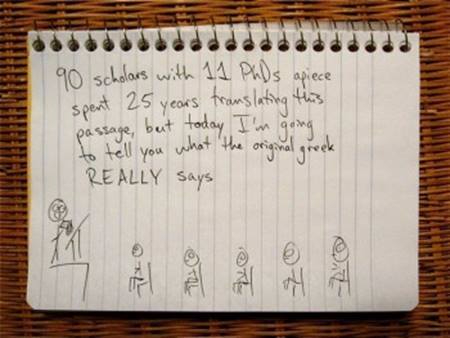
“But the Greek REALLY says…” Why Greek and Hebrew are not needed in the pulpit, Part 3
In Part 1 and Part 2 I offered one individual's philosophy of Expository Preaching without Ancient Words: I use the biblical languages, virtually daily. [1] I cannot remember the last time I did not study the Hebrew or Greek when I was preparing a sermon. I cannot remember the last time I did use a... Continue Reading →
Review of my Thessalonians commentary
The Review of Biblical Literature just published its review of my Zondervan commentary: http://www.bookreviews.org/pdf/8733_9615.pdf The only objection that I might offer is that he seems to have misread my study of the textual variants ηπιοι versus νηπιοι in 1 Thess 2:7. The fact that he say "nepioi" and read it as "epioi" was, ironically, the... Continue Reading →
“But the Greek REALLY says…”: Why Hebrew and Greek are not needed in the pulpit, Part 2
In Part 1, I argued in favor of a sharply minimalist use of ancient Hebrew and Greek words during a sermon, especially if there is no compelling purpose or, worse, if the goal is to impress the crowd: it is a pitiable housepainter who departs the job with his scaffolding still up, hoping you’ll notice... Continue Reading →
“But the Greek REALLY says…”: Why Hebrew and Greek are not needed in the pulpit, Part 1
Para la versión castellana, vaya AQUI. Come with me to ESEPA Seminary in Costa Rica: we meet at night around a table, and with me are all my advanced students of Greek. Throughout four semesters we have studied the ancient dialect, koinē, and they have found blessings as they read the New Testament in the... Continue Reading →