It appears to be the busy season of people telling us when Jesus will return. I have seen five dates for the period of September-December 2015 and others for 2016 or 2017. Four of those dates have already passed us by. Whether these date-setters claim to be prophets or not, they all transgress the Lord’s warning... Continue Reading →
How to Calculate when Jesus will Come – without even being a prophet!
Download the entire article here: Shogren_How to calculate when Jesus will come I originally wrote this as a response to the outbreak of Blood Moon Fever and the Shemitah Virus - remember those false panics? - and more broadly, to the rapidly-spreading epidemic of predictions of Jesus’ near return between 2015-2017. And people predicted 2018, 2019,... Continue Reading →
“The Paranoid Style in American Politics” has its 50th Anniversary
[One of my few blog entries on politics, and how it relates to psychology, sociology, and modern apocalyptic eschatology. Here is a full pdf version: Paranoid Style Turns 50_Shogren] Because of his ability to describe and predict American political behavior, Richard Hofstadter’s “The Paranoid Style in American Politics” should be required reading for the citizen. And... Continue Reading →
The Eclectic Text of the New Testament – a conspiracy against the Word?
God’s beloved Word – you'd better believe I study it daily. Yes, as a Bible teacher, since my ministry is teaching the New Testament in Spanish and English, and also from the Greek. But more fundamentally I read the Bible simply as a Christian, because it is through the reading, meditation, and obedience of God’s Word... Continue Reading →
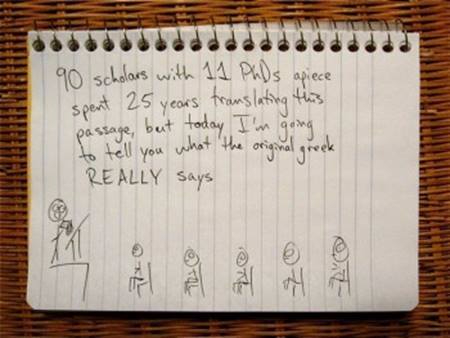
“But the Greek REALLY says…”: Why Hebrew and Greek are not needed in the pulpit, Part 2
In Part 1, I argued in favor of a sharply minimalist use of ancient Hebrew and Greek words during a sermon, especially if there is no compelling purpose or, worse, if the goal is to impress the crowd: it is a pitiable housepainter who departs the job with his scaffolding still up, hoping you’ll notice... Continue Reading →
“But the Greek REALLY says…”: Why Hebrew and Greek are not needed in the pulpit, Part 1
Para la versión castellana, vaya AQUI. Come with me to ESEPA Seminary in Costa Rica: we meet at night around a table, and with me are all my advanced students of Greek. Throughout four semesters we have studied the ancient dialect, koinē, and they have found blessings as they read the New Testament in the... Continue Reading →
The Critical Text and the Textus Receptus in 2 Thessalonians [Studies in Thessalonians]
Most Christian scholars use what is called the Critical Edition of the Greek New Testament, and almost all modern versions are based upon it. There are several camps that prefer other editions, the Textus receptus or the Majority Text. Some do so because of a belief that it better represents the original; I think they... Continue Reading →