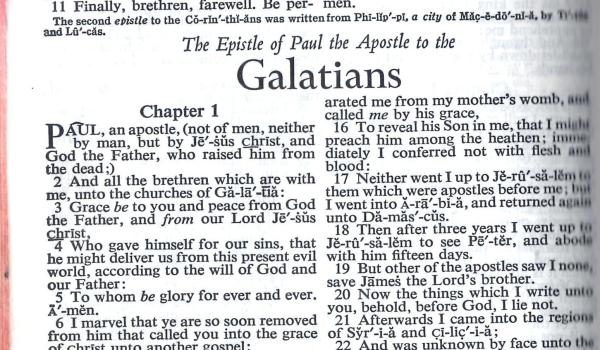
In September 1972, I picked up a Bible, opened it and began to read it for myself. To be sure, I had grown up in a Bible-believing Baptist church. I went to Sunday School, memorized Bible verses, could recite the books of the Bible. I knew what Revelation was about and the basic plot of... Continue Reading →
Go right to the Bible! by special guest writer, Karen Shogren
I offered to teach my hairdresser how to study the Bible. Her counteroffer: every Thursday she’d close up shop and I’d teach her entire staff! “Now, we’re all from different backgrounds,” she said. “But you’re going to teach about us how to study the Bible for ourselves, not promote a specific denomination, right?” Next Stop:... Continue Reading →
How I have devotions
Part of my traditional New England upbringing was to learn to maintain boundaries between private issues, family matters, and public information. When I asked my parents what they were talking about, at times I heard, “Well, it doesn’t concern you.” Nothing gruff, like “it’s none of your business,” no “you wouldn’t understand.” Just, “if you needed to... Continue Reading →
How does one choose a Bible commentary?
"When you're deciding which commentary to add to your library, what are the most important things to consider?" So asked Logos Bible Software on Facebook? To summarize my response: 1. Careful attention to the text, not an "agenda" (I see too many famous "exegetes" who merely reiterate what they already "know to be true"). I'm... Continue Reading →
Bible Commentaries and Dictionaries, a word of advice from Logos and myself
Kyle Anderson from Logos software just published a fine article on how to use Bible dictionaries. He warns against simply reaching for a commentary when we are studying the Bible. I heartily applaud this basic sentiment. As Christians, we are supposed to be enjoying the Bible, not reading the tale of how some other person... Continue Reading →
What books have I used to write a commentary on 1-2 Thessalonians? [Studies in 1 Thessalonians]
Note: In November 2012 I published a commentary of 1-2 Thessalonians for Zondervan (click HERE). The advice given below is applicable to all preaching and writing projects. I used to do business at a local office building. On the wall was an engraved map of the New World from the 1600s. It was a real... Continue Reading →
God’s Will and Paul’s Missionary Plans, or, How did Paul know where he was supposed to go?
Let us say then that a Christian believes that God is calling him or her to the mission field. One of the most pressing questions, always, is: I know I’m going...but where do I go? How can I be sure when the whole needy world lies before me? The church does not have the privilege... Continue Reading →
Logos and Thayer’s Greek-English Lexicon (updated)
How strange it is, that I, a student and professor of the Greek New Testament, would object to the electronic publication of a classic Greek-English dictionary! Yet object I must. Baur and LSJ are top-of-the-line lexicons. They draw from discoveries that have been made of hitherto lost books from antiquity, and especially of the papyri and inscriptions. Besides which, digital databases such as Thesaurus Linguae Graecae (or TLG; ancient books) and the Packard Humanities Index (PHI; papyri and inscriptions) now put within the reach of all interested students the ability to search through almost all known ancient material within minutes. We might reason – if two lexicons are good, then wouldn't three be better? The answer is a firm no. For example, Thayer states that the word agapē was invented by the inspired translators of the Septuagint in the 3rd. cent. BC, and that pagan Greeks had not previously known of the word. Using advanced software I was able within an hour to disprove Thayer in great detail, demonstrating that agapē was known and used in pagan Greek – although not frequently – long before the translation of the Septuagint and after its publication, yet in works that show now Jewish or Christian influence. Was Thayer mistaken? No he was not...given the data that were available when he wrote. But new data have come to light since then, invalidating their statements. Some people have the idea that Thayer, being a classic, will provide a fresh and perhaps more spiritual perspective. This is not the case. The person who reads Thayer cannot simply weigh his opinion against Baur’s and decide which he or she prefers. LSJ and Baur, whose conclusions are not fallible and are sometimes debated, will always have a decisive edge over an older lexicon simply by having publication dates of 1997 and 2000 respectively. We must use the very best tools that are available, and we must be prepared to pay the appropriate cost in order to make use of recent research, even the $150 for Baur. Or, we must commit ourselves to seek out the best tools where we can find them – in a library, or using Liddell, Scott and Jones gratis from the Perseus website! (www.perseus.tufts.edu). I’m sorry to conclude that, by publishing Thayer, Logos – of which I am a devoted fan – is part of the problem. See also my post: “What books have I used to write a commentary on 1-2 Thessalonians?”