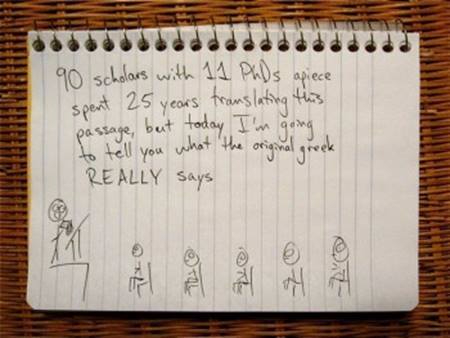
In Part 1 and Part 2 I offered one individual's philosophy of Expository Preaching without Ancient Words: I use the biblical languages, virtually daily. [1] I cannot remember the last time I did not study the Hebrew or Greek when I was preparing a sermon. I cannot remember the last time I did use a... Continue Reading →
“But the Greek REALLY says…”: Why Hebrew and Greek are not needed in the pulpit, Part 2
In Part 1, I argued in favor of a sharply minimalist use of ancient Hebrew and Greek words during a sermon, especially if there is no compelling purpose or, worse, if the goal is to impress the crowd: it is a pitiable housepainter who departs the job with his scaffolding still up, hoping you’ll notice... Continue Reading →
“But the Greek REALLY says…”: Why Hebrew and Greek are not needed in the pulpit, Part 1
Para la versión castellana, vaya AQUI. Come with me to ESEPA Seminary in Costa Rica: we meet at night around a table, and with me are all my advanced students of Greek. Throughout four semesters we have studied the ancient dialect, koinē, and they have found blessings as they read the New Testament in the... Continue Reading →
Buy Strack and Billerbeck’s Commentary – but beware! [technical article]
Logos.com has published Strack-Billerbeck's Commentary on the New Testament from the Talmud and the Midrash (published in the 1920s) in German; it will bring out the English translation in November, 2021. For years I've said this should be translated! And despite its flaws it's still unequaled, and the price of $149 for the English-only version... Continue Reading →
False teaching – a corrosive, toxic, contaminant
This is how false teaching arrives: A man with a white lab coat and rubber mallet in his pocket protector arrives in order to “heal you.” And just think, you didn’t even know you were sick! Still, after hmms and haws, he pull a bottle of medicine from a pocket, holds your nose and chucks... Continue Reading →
Jesus? Yeshua? Yahushua? Which is the ‘real’ pronunciation?
From my ministry in Central America, I understand how names change from language to language: the English form of my name “Gary Shogren” is difficult for the Spanish-speaker – the “a” and the “e” don’t have exact counterparts in Spanish; nor does “sh”. I say my name one way if I’m speaking English and another... Continue Reading →
Is Bible memorization a good use of our time?
I just wrote a post in which I gave advice to a younger Christian, and I urged him to memorize Scripture. A reader questions the value of Bible memorization compared with other Bible activities. He says: I would say focus on reading comprehension and understanding what you are reading and ask questions whenever possible -... Continue Reading →
I have been to Magog, and seen the grave of Gog
Link - How to calculate when Jesus will come - without even being a prophet! In my first days as a Christian, they filled me in that the Soviet Union was predicted in Ezekiel 38-39 and that Russia and the Warsaw Pact countries would attack Israel at any time. Hal Lindsey’s The Late Great Planet Earth... Continue Reading →
May Christians create holidays such as Christmas?
May Christians create holidays? The Bible gives us precedent to say Yes. First, God’s people have always celebrated holidays that are not mandated in the Bible. To name three, the feast of Purim was established in the 400s BC, when Esther and Mordecai saved the Jews from slaughter. The name Purim is the Hebrew form... Continue Reading →
My four decades in the Bible – Part III
Chapter Five – I start to teach others For two years I had been taking in the Bible and growing in prayer and evangelism. I served a summer as a camp counselor at Camp Pine Ridge in Rumney, New Hampshire. The older counselors were students at Bible college, and they told me that the New... Continue Reading →