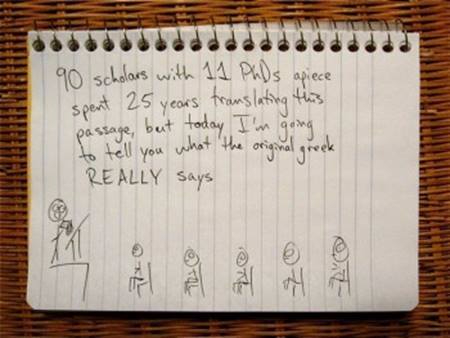
In Part 1, I argued in favor of a sharply minimalist use of ancient Hebrew and Greek words during a sermon, especially if there is no compelling purpose or, worse, if the goal is to impress the crowd: it is a pitiable housepainter who departs the job with his scaffolding still up, hoping you’ll notice... Continue Reading →
“But the Greek REALLY says…”: Why Hebrew and Greek are not needed in the pulpit, Part 1
Para la versión castellana, vaya AQUI. Come with me to ESEPA Seminary in Costa Rica: we meet at night around a table, and with me are all my advanced students of Greek. Throughout four semesters we have studied the ancient dialect, koinē, and they have found blessings as they read the New Testament in the... Continue Reading →
Is the NIV 2011 a Satanic, Homosexual, PC Bible? Part II
Click here to read Part I, which is necessary to understand this Part II. Some take issue with the 2011 update of the New International Version. For example, here’s the official statement from the Council of Biblical Manhood and Womanhood: As the evangelical community turns to CBMW for trusted counsel on contemporary Bible translations that... Continue Reading →
Is the NIV 2011 a Satanic, Homosexual, PC Bible? Part I
Search for comments on the new NIV by Google, and you will find bloggers talking about its “feminist agenda”, “Satan’s lies”, “end-time deception” and that “the homosexual community is excited about the new perversion of the Bible.” (They provided no statements from gay groups, expressing their glee). At its annual convention last year, the Southern Baptist... Continue Reading →
The Critical Text and the Textus Receptus in 2 Thessalonians [Studies in Thessalonians]
Most Christian scholars use what is called the Critical Edition of the Greek New Testament, and almost all modern versions are based upon it. There are several camps that prefer other editions, the Textus receptus or the Majority Text. Some do so because of a belief that it better represents the original; I think they... Continue Reading →