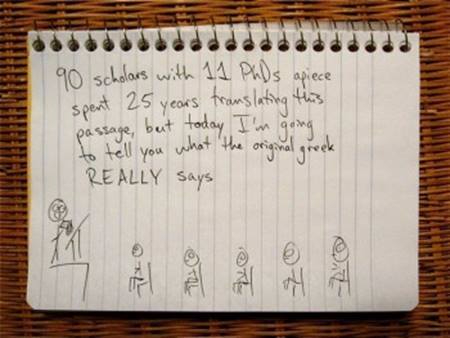
In Part 1, I argued in favor of a sharply minimalist use of ancient Hebrew and Greek words during a sermon, especially if there is no compelling purpose or, worse, if the goal is to impress the crowd: it is a pitiable housepainter who departs the job with his scaffolding still up, hoping you’ll notice... Continue Reading →
“But the Greek REALLY says…”: Why Hebrew and Greek are not needed in the pulpit, Part 1
Para la versión castellana, vaya AQUI. Come with me to ESEPA Seminary in Costa Rica: we meet at night around a table, and with me are all my advanced students of Greek. Throughout four semesters we have studied the ancient dialect, koinē, and they have found blessings as they read the New Testament in the... Continue Reading →
Is sin “missing the mark”?
Have you been told that the "sin" literally means "missing the mark" in the original Greek? In fact, it does not. The verb "hamartano" (αμαρτανω) was sometimes used in pre-Classical and Classical Greek to refer to missing a target. Homer uses it in the Iliad to speak of a man who failed to hit his... Continue Reading →
Which Bible version is the most “literal”? (updated)
“Literal” is really not a technically precise term, because some people take it to mean “more faithful”, and this is simply not the case. The KJV is fairly literal, the NASB more so. The NIV, NJB, and others are more in the “dynamic equivalent” camp. Some people who opt for “literal” translations disdain these Bibles... Continue Reading →